
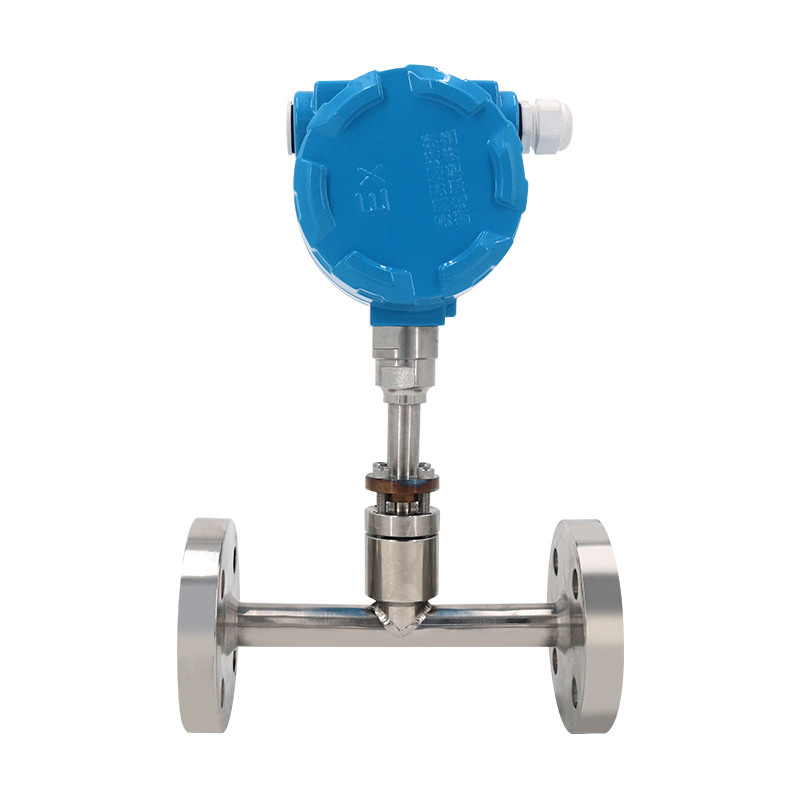
Product Details
Thermal mass flow meters employ the thermal diffusion principle, a technology renowned for its excellent performance and high reliability under harsh conditions. Its typical sensing elements include two thermistors (platinum RTDs): one serves as a velocity sensor, and the other acts as a temperature sensor that automatically compensates for changes in gas temperature. When these two RTDs are placed in the medium, the velocity sensor is heated to a constant temperature difference above the ambient temperature, while the other temperature sensor detects the medium's temperature. The mass flow rate of the gas flowing through the velocity sensor is calculated based on the amount of heat transferred by the sensing elements. As the gas velocity increases, more heat is transferred from the sensor to the medium, requiring more power to maintain the temperature difference. The power supplied by the electronic unit to heat the RTD is thus correspondingly related to the mass flow rate.
Application Scope and Features of Thermal Mass Flow Meters
1. Mass calculation and standard volume measurement to reduce metering errors;
2. Proprietary flow data model algorithms to achieve high linearity, high repeatability, and high accuracy;
3. High-performance intelligent microprocessor and analog-to-digital/digital-to-analog conversion chips;
4. Wide range ratio of 1:1000; when measuring large-diameter low-velocity flows, pressure loss can be neglected, with high sensitivity to low velocities and minimum measurable flow as low as 0.05 m/s;
5. Simple selection, installation, use, and maintenance; online disassembly and maintenance without interrupting flow (insertion type);
6. No moving parts, so vibration effects can be ignored;
7. Insensitive to small particles such as dust, suitable for flow measurement of various single or mixed gases.